My journey around the sun begins today. Why am I travelling around the sun? And why does it start today? Well, today is my birthday. And, as the Earth completes another lap in its endless orbit around the sun, I begin another year of my own adventures. However, I am not the only one—we are all spinning through the universe on Spaceship Earth.
I never gave much thought to all this “spinning” around the sun until a friend sent me a birthday text wishing me the best ever “trip around the sun.” I had to stop and think about what that meant. It is a wonderful way to ponder growing another year older! It’s just another trip around the sun!

May is Sunshine Month
Speaking of the sun, May is “Sunshine Month” according to the Grassroots Health Foundation. The foundation encourages people to focus on getting outside and enjoying the benefits of sunshine. The benefits are many, and research is discovering that sunshine may actually be critical to health. Humans were never meant to live under rocks or in dark caves.
How Much Sunshine do You Get?
It turns out that sunlight acts not only as a source of vitamin D production, but also as a powerful biological signal that influences circadian rhythms, autonomic function, mental health, mitochondrial activity, and recovery processes. At least, this is according to the German researcher Dr Alexander Wunsch. His article on sunlight and health is fascinating, and the accompanying video is well worth watching because it is packed with well-supported research.

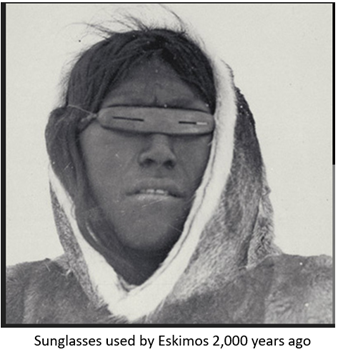
If you are a hermit and live under that rock I talked about, never getting any sunshine, you may be overlooking the larger impact of sunlight on health and longevity. Staying inside is one way that people avoid the sun, but another is the obsessive use of sunscreen, protective clothing (as shown in the photo above), and sunglasses to block it. (See more about this here and here). Why would anyone want to avoid such a life-giving force? Understandably, if you live in the desert with unrelenting sunshine, it would be prudent to moderate your exposure, but otherwise…enjoy the sun!
Researcher Alexander Wunsch also tells us that there are two complimentary pathways through which sunlight affects the body—one is your skin, and the other is your eyes. They work together.
Sunlight on your skin (provided it is in a controlled manner) supports vitamin D synthesis, nitric oxide release, cell signaling, and photo-biomodulation effects (such as from red and near-infrared light).
Sunlight entering your eyes helps set your circadian clock (sleep/wake cycle), regulates melatonin and cortisol, supports serotonin and dopamine signaling, and improves mood, alertness, and cognition. Hence, walking around without sunglasses on may be beneficial. You may ask “But aren’t there times when you really should wear sunglasses?” Yes, sunglasses are generally suggested when there is extreme glare from snow or water.
Sunlight is Essential But Must be Balanced and Optimized, Not Avoided.
New guidelines from the Grassroots Health Foundation suggest that our skin type helps determine how much sun exposure we should get. Those of us with lighter skin—such as people with ancestry from northern Europe—need to start with smaller doses of sunlight and avoid sunburn. Those with medium to darker skin tones (such as people whose ancestors originated closer to the equator) can generally tolerate more sun exposure. Darker-skinned individuals also need to stay in the sun longer to produce the same amount of vitamin D as a light-skinned person.
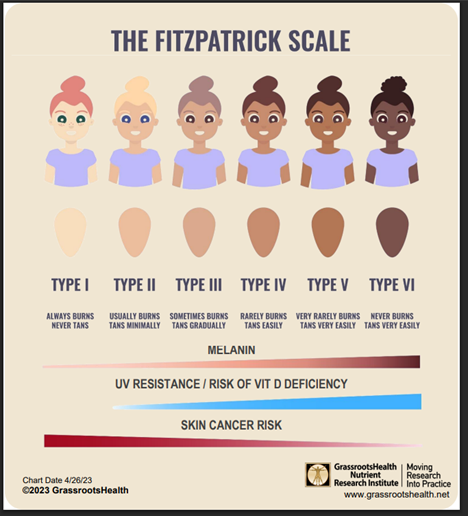
Of course, there is always a risk of skin damage and cancer from excessive sun exposure. But did you know that people with darker skin tones have much lower rates of skin cancer than light-skinned populations? Fascinating, isn’t it?
Some researchers argue that the health risks associated with too little sunlight and low vitamin D levels may outweigh the risks of melanoma for many people. This idea was highlighted in a large UK study involving roughly 400,000 participants.
The research said: While avoiding UV exposure may prevent a relatively small number of skin cancer deaths, it was associated with a substantially larger increase in deaths from other causes.
Vitamin D and Disease
Sunshine does a body good, and one of the main benefits of sunshine is that it helps the body produce vitamin D. Yes, there is always the hazard of skin cancer, from excessive sun exposure. However, vitamin D deficiency—which affects over half the global population—is itself associated with increased risks of chronic diseases, including certain cancers, autoimmune conditions, and cardiovascular disease.
Vitamin D Has Anti-Cancer Activity
Physician, Paul Marik has been focusing on alternate therapies for treating cancer. In his recent Substack article, Vitamin D and Cancer: The Missing Link Oncology Keeps Ignoring he explains the link between vitamin D and cancer.
Getting enough sunshine raises vitamin D levels, and vitamin D appears to play an important role in regulating cell growth and immune function. Vitamin D is actually a hormone. It binds to receptors throughout the body and helps regulate cell growth, differentiation, and survival. Research suggest that the majority of patients with cancer are vitamin D deficient (level < 20 ng/ml). Do you know your vitamin D level?
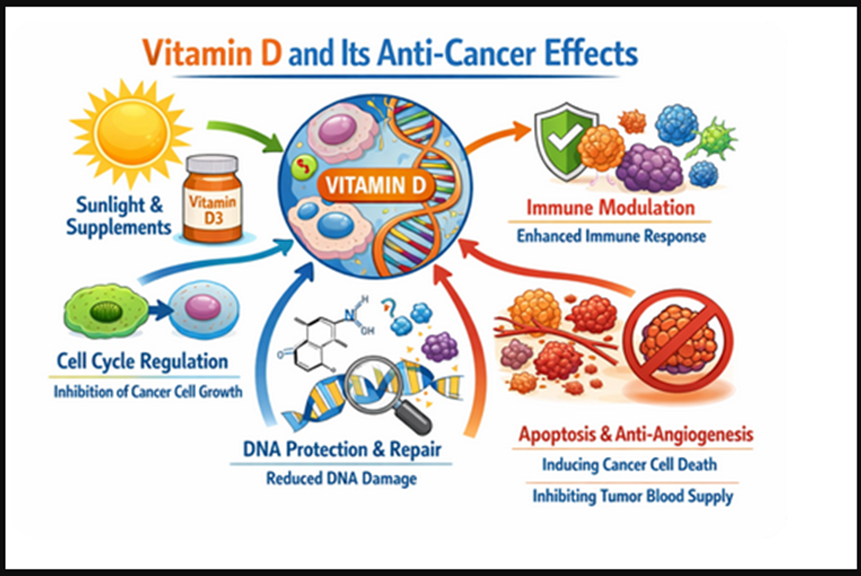
If you don’t know your vitamin D level, you can ask your doctor at your next visit. But don’t wait that long. The easiest “home finger-stick test” that I have found is through Grassroots Health. It only requires 4 drops of blood per test, and costs about $79. Go HERE to find out more. Grassroots Health recommends keeping blood levels between 40-60 ng/ml. Some research suggests it may be beneficial to have higher levels when dealing with cancer.
Of course, marketing campaigns like the one below (“Sun Responsibly”) can fuel a sense of fear that is unnecessary. I came across this poster in my local Walgreens. It states that “more than 2 people die of skin cancer every hour”. It sounds horrific. But let’s look more closely. That number is not accurate. It is closer to about 1 death per hour (based on CDC data). And let’s put that in perspective: total cancer deaths are about 68 per hour in the U.S. which is much higher than melanoma skin cancer. Skin cancer is comparatively low.
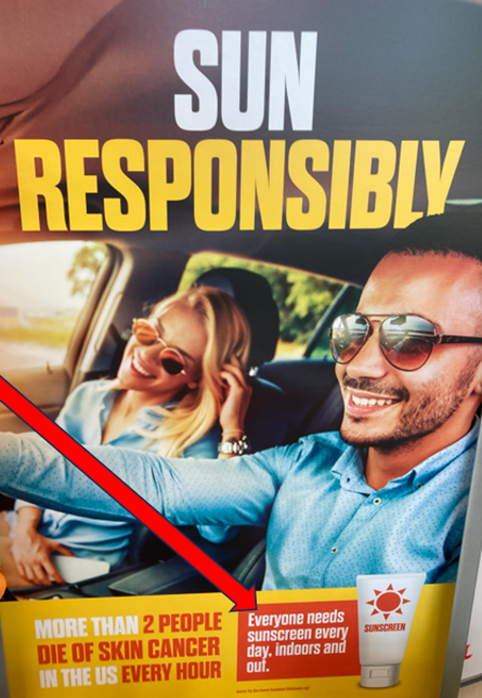
And look at what else the poster says—”Everyone needs sunscreen indoors and out.” I was shocked. The sun is not shining into my living room (glass windows block UV light). I don’t know about you, but I’m not walking around my house with sticky sunscreen on! This is an irresponsible poster bent on selling you more sunscreen.
Go Play Outside

Did your mother ever tell you to “go play outside” when you were a kid? She knew that the healthiest place for you was outside in the sunshine. And she meant it! Your mother probably did not slather sunscreen all over you, and she certainly did not hand you sunglasses. She gave you a boot in the pants and sent you outside.

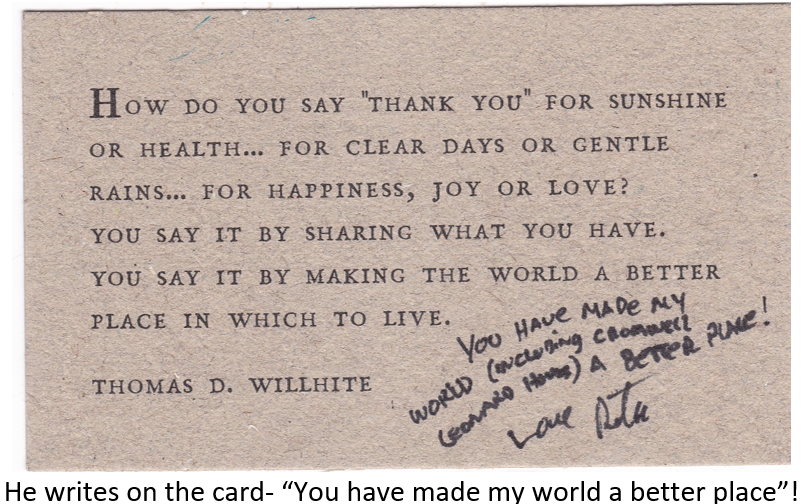
The sun certainly called me outside on my birthday. I wandered around my garden soaking up the sunshine, with my bare feet grounded on the earth. I did not apply sunblock; I did not wear sunglasses. Just me, the Sun, and Mother Earth. The day ended with a wonderful Birthday card from my brother!
I welcome your comments (scroll down). Always talk to your health professional before starting anything new. This information is not intended to diagnose, treat or cure any condition and is intended only for entertainment.
Nice research, very interesting, as well, S.
Happy Belated Birthday! As usual an article chock full of intriguing and fascinating info, including a hint of trips around the sun to come. Hmm, seems I may be that one who lives under a rock, but seriously since being in AZ, I’ll turn pink in just 2 minutes. I do so miss the climate in San Francisco, city of winding ways and misty mountains. Sunscreen inside indeed. Beautiful card from Peter.
Happy Birthday Jackie! I just wrote a newsletter on the benefits of sun also. I also point people at the http://www.ewg.org website to pick out non-toxic sunscreens. I am very fortunate to have “olive skin” and I can tolerate a lot of sun!