Imagine sitting in a beautiful New England home—a colonial built in the mid-1700s—and listening to Christmas music played on a harp. That is what I did this past weekend, and it was mesmerizing. The colonial house was previously owned by Senator Cromwell Leonard of Massachusetts (below is a photo of Mr. Leonard himself as he stands in front of his fireplace). No… wait… that is not the good Senator; that is actually my brother, the current owner of this 300-year-old home!
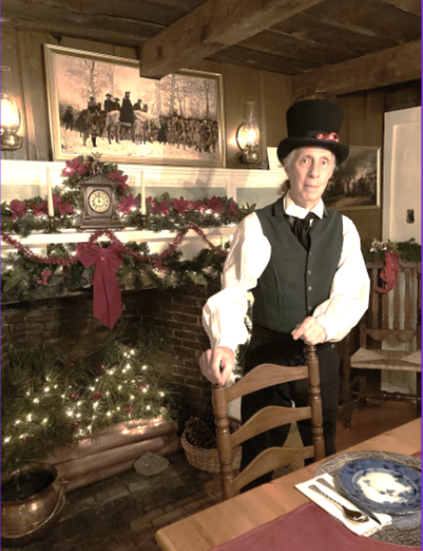
My brother plays the part well and graciously invites friends and neighbors into his meticulously renovated home to enjoy a meal and listen to the melodies of the harp. (There’s no indication that Senator Cromwell played the harp!)
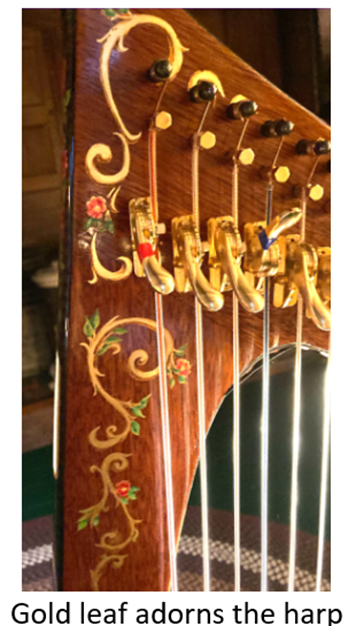
The harp is a beautiful instrument—made even more lovely when it is built by hand and etched in gold leaf. My brother not only renovates old colonial homes, but also builds and plays Celtic harps. He is a self-taught harpist, which is a far cry from the days when he played tuba in our high school band! He even learned how to apply gold-leaf from our mother, who decorated many antiques around our home.
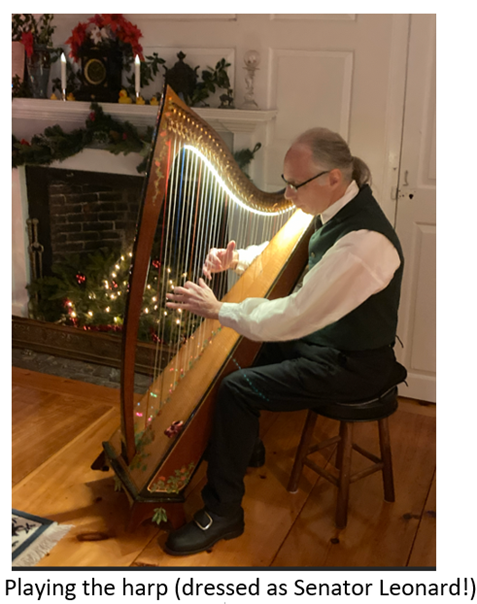
At Christmas time my brother loads his harp into the car, and treks out into the community to bring his talents to area hospitals, churches, shrines, and even a garden center. I joined him one bitter cold morning in a hospital lobby (harps don’t like going out in the cold—they go out of tune!) and sat watching people come and go while he played wonderful Christmas melodies. Below, my brother plays the “Garden Harp” as he has named this one.
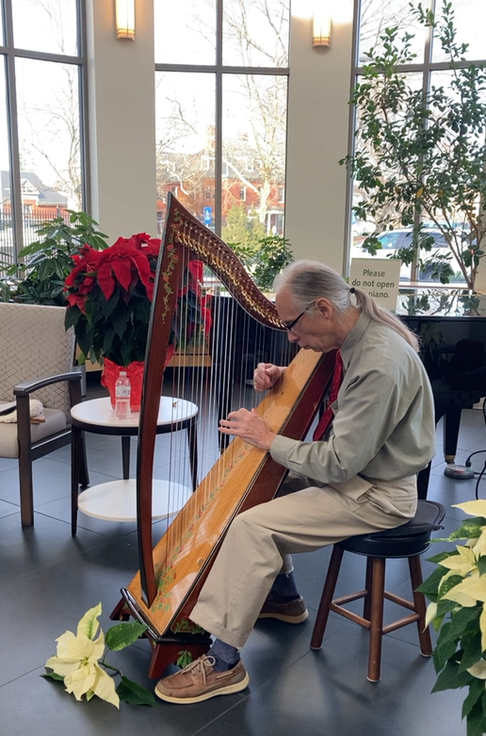
People were coming to the hospital for medical care and were not expecting to be entertained by a harp, so many of those I observed hurried along to their next appointment—including hospital staff. I wondered if they thought they were hearing some far-off “elevator music” and simply weren’t paying attention? After all, harps are not very loud, and it would be easy to overlook them.
However, there were some people who paused to watch or discreetly looked over their shoulder to catch a glimpse of the musician. I remember one middle-aged man bringing an older relative into the lobby—he kept turning to look across the room at the harp, one, twice, three times, and then had to hurry down the hall with his family member.
Then there was the “book lady,” as I called her, sitting not far away, watching the harp more than she was reading her book. There was also a “book man” who kept walking back and forth in front of the harp, book clenched tightly under his arm. An older couple stood watching—the woman with her head cocked slightly, listening. A nurse in scrubs sat near me; maybe she was on break? And then a young man came up the stairs and tripped on the way up, but caught himself —perhaps he was paying too much attention to the harp?
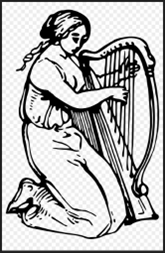
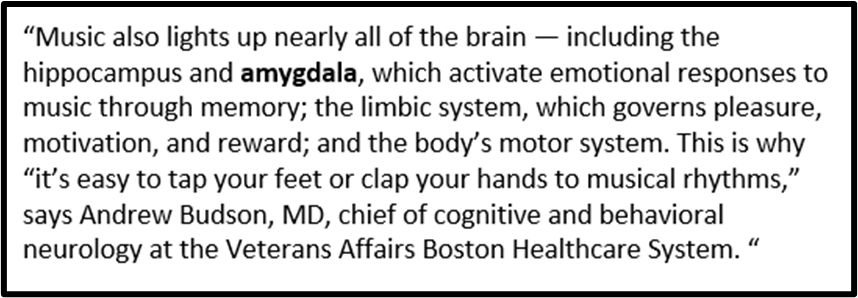
A hospital employee arrived wearing a sweatshirt with the hospital slogan “More than Medicine” printed on the back. I don’t know much about this hospital, but the harp’s charming melodies are certainly more than medicine. They may even be stimulating an emotional component of our brains. Every time I hear my brother play this beautiful instrument, I start to tear up. Kleenex in hand, I’ve tried to figure out why this happens to me. For one thing, my brother comes from a long line of artists and musicians in our family, and that brings back wonderful memories of my parents and grandparents. That alone is enough to make me tear up!
And I am not the only one. A lady across the room blows her nose…was she tearing up? No—maybe it’s just the cold weather. That said, it is well known that music evokes an emotional response in us. Many listeners have approached my brother after he finishes a piece and said things like, “you changed my feelings today,” or “I felt something here,” or “it took me back to my childhood and the good feelings about Christmas.” Once, while playing at a Catholic shrine, my brother mentioned these observations to the priest. Father Brown suggested, “Tell them, ‘You just received a gift.’”
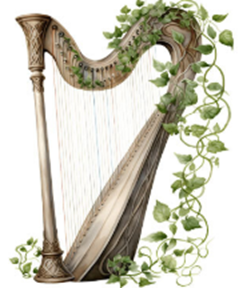
Music is a gift—a gift from humanity to humanity. It impacts our brains and has long been known to augment healing. For example, listening to Mozart’s Sonata for Two Pianos in D Major can reduce the frequency of seizures in some people with epilepsy (here). It is known as “the Mozart Effect” (there is a book by the same name.) Music resonates—literally—in our brains.
Overtones and harmonics
How does the harp do this? In the words of my brother- “The harp produces a sound quite different than most other instruments, and I think that is what makes it touch our soul. When you pluck a string on a harp (such as an “A” string), it sets the soundboard vibrating which produces both the fundamental tone (the “A”) and its associated harmonic overtones. And, that vibrating soundboard also sets all the other strings vibrating as well. This in turn, gets all their associated overtones sounding. Only the harp really does this most effectively. I have 36 strings on the harp and everyone is directly connected to the soundboard – so more opportunity for harmonics and a richer sound.”
But, thanks to my brother, we don’t need to understand the science behind music and its effects on our brains, to enjoy it. Humans have been creating music—and musical instruments—for tens of thousands of years. Archaeologists have discovered bone and ivory flutes made from tusks in present-day Germany, dating back roughly 40,000-50,000 years.
Only humans can intentionally design and create instruments.
Only humans compose music with structure, repetition and variation.
Only humans use music in rituals, storytelling and healing.
Back in the hospital lobby, I noticed a woman taking a picture of my brother as he played the harp. I struck up a conversation with her and learned that she was waiting for her son to come out of surgery. She was taken with the beauty of the harp and its music, and I felt glad that this brief musical interlude could offer her some comfort.
I leave you with a link to hear the harp and a wonderful photograph of the Cromwell Leonard house—a place where harps are born.

Always talk to your health professional before starting anything new. This information is not intended to diagnose, treat or cure any condition and is intended only for entertainment. I welcome your comments.
Yes, this was my favorite 2025 post of yours! While it wasn’t your usual scientific, information- filled version, it was so heartwarming and interesting. Keep up the great work… and remember, to change it up your themes, every once in a while!
What a lovely post, Jackie! I love harp music and will go out of my way to hear it any time I can.
Between being a harpist and caring for such a beautiful, historic home, your brother sounds like such an interesting person!
Hi Jackie,
We are beyond grateful to have your brother Peter volunteer his valuable time to play beautiful music for our visitors, patients and staff. The gentle sound of the harp most certainly brings tears to my eyes, as the music is simply “angelic”…and very healing for the soul.
Merry Christmas and Happy Healthy New Year….thank you Peter, for sharing your gift with all of us.
Thanks Donna!
Jackie – What a tremendous tribute to Peter! All of your observations are spot on especially those about the healing attributes of music. It is not too infrequent when after a particularly stressful day of work, I can swing by Peter’s home, bask in the 300 year old ambiance of his historic home while reclining on the sleeping bench in his East Parlor and slowly unwind as his harp playing wafts over me. It is truly restorative. This blog post is to me what amounts to a wonderful Christmas gift to your brother Peter. Thank you for sharing it!
Well, not only does the harp bring tears to my eyes, but your wonderful comment does as well! I am so glad he has a best friend such as yourself!
I really enjoyed reading this festive post, especially the pictures and your descriptions of the peoples reaction to Peters’ harp. I bet Senator Cromwell Leonard would have loved attending one of Peters’ dinners. Merry Merry!
While in college, I went down a music rabbit hole. Not seriously, my other pursuits had a strong hold on my time, but it is fascinating even for a haphazard scholar. Check out Bach’s mathematical theories and “The Music of the Spheres.” The idea is that music is actually how God spoke Creation and that it resonates (musically) throughout the universe, visually and physically as well.
I love this! Music is how God spoke Creation and it resonated through the universe! This fits so well with my blogs on sunlight, UV light, and grounding to Mother Earth.
Thank you for sharing. Music always lifts my spirits!
Dear Jackie,
Thank you for posting such a wonderful blog about the harp, your brother and my old house. It is nice to see it restored and having live music again in its halls. People in your age have forgotten the healthful effects of sitting and listening to (or creating) live music. It invigorates not only your soul but your body as well.
Sincerely, Senator Cromwell Leonard, Dec. 16, 1858
Wow! Thanks Senator Cromwell for coming back from the past and posting a wonderful comment on my website! So glad you are hovering over the Cromwell Leonard house and keeping watch over my brother the harpist!