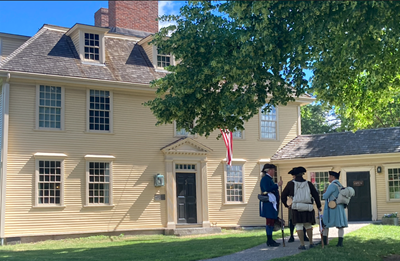
I’m standing in the tavern that Samuel Adams and John Hancock stood in at the start of the American Revolution. The tavern—named the Buckman Tavern—in Lexington, Massachusetts, was called the “headquarters of the American Revolution”. It was the gathering place for the Patriots of Boston. They plotted, planned, and strategized how they would push back on the intrusive soldiers of the British army. I was there.
Of course it was 2026, not 1775 but you get the idea.
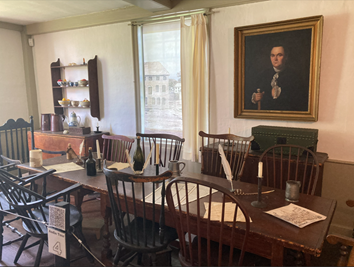
The Front Meeting Room
As I looked around the quaint meeting room that I had just entered, my heart pounded, knowing that their courage and strength were crucial to forming our early country. Talk about bringing history alive! The tavern was fully restored, right down to the bar and supporting kitchen in the back of the building. It saw some violent action in 1775 as there is a bullet hole in the original front door!
Even though John Hancock and Sam Adams are larger than life figures in our history books, they were likely small in stature and physical size. The table and chairs in front of me, albeit inviting in their quaintness, were diminutive in size. The chairs would only be comfortable for a child today.
The tavern, built in 1737, sits in the heart of Lexington. The large village green (the Lexington Common) in front of the tavern is surrounded by a historic church and beautiful colonial homes—silent witnesses to the first armed confrontation between the American colonists and British soldiers.
Just a short walk away, stands the Hancock-Clarke house where John Hancock and Samuel Adams were staying in April of 1775. It was here that Paul Revere, on his famous midnight ride from Boston, arrived to warn them that British troops were marching toward Lexington.
But wait a minute—why were the British heading to Lexington and Concord in the first place? And weren’t the early colonists “British” themselves? After all, most had come from England, and all were subjects of the British Crown. So why had they begun to think of themselves as something different (Patriots)? These were the questions I found myself asking as I began my visit to these historic New England towns. Let’s find some answers.
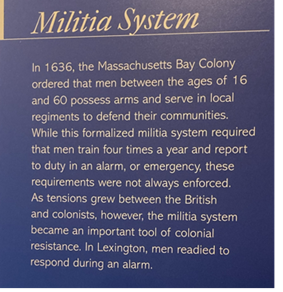
A Very Short History
As you see in the box above, the Massachusetts Bay Colony needed protection—mostly from Indians and French intrusions. They formed militias of the local citizens. No problem there. It was quite necessary, and apparently England did not object.
In the meantime, as Boston grew, it became an historic seaport by the late 1700s. Even though it built a militia for local protection, it still relied on the motherland (England) for many supplies and goods.
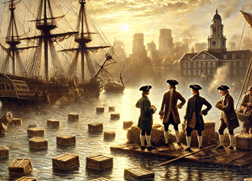
But the British had imposed “taxation without representation” and many other punitive measures on the city and the surrounding areas. The British army, stationed in Boston, would often search private homes and put undue pressure on the local economy. Then, the British closed the port of Boston in a punitive measure for the “Tea Party” revolt, which caused much distress and hardship among the local citizens who were getting more and more upset due to disruptions in their local commerce.
Over time, the early colonists (“Patriots” as I will refer to them, but not to be confused with the local football team!) had already amassed a militia of about 15,000 men arrayed around the towns surrounding Boston. They also assembled stores of supplies – muskets, gunpowder, cannons, and other military ordnances. Many of these supplies were stored in and around the towns of Concord and Lexington. That is quite an extensive “army” and it made the king of England (King George III) and the royal Parliament a bit nervous. They feared that open rebellion by the Patriots was no longer just talk—it was becoming a well-organized movement.
The British decided to track down and destroy these supplies, and to locate and arrest Patriot leaders John Hancock and Samuel Adams. Yes, Hancock and Adams—our heroes—were regarded as the leaders of the rebellion and enemies of the crown. They had to be stopped!
But the local Bostonians had spies planted around the area and found out about the British plans to march on Lexington and Concord. The Patriots needed a plan to alert the local militia in the towns leading up to Lexington and Concord that “the British were coming!”
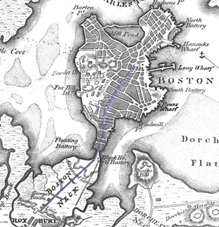
Boston at that time, was nearly an island – only a narrow strip of land called Boston Neck connected it to the mainland. The British army had two possible routes to move the troops to Lexington—over land—the long way—or taking small boats across the harbor (the sea), the shorter way. They planned to do this at night on April 18, 1775,to catch the Patriots by surprise.
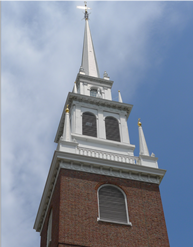
But, on that night two lanterns were lit and placed high in the bell tower of the “Old North Church”. This is where “One if by land, two if by sea” was penned by Longfellow. Two lanterns in the bell tower alerted the community that the British were coming across the harbor. Paul Revere and several other riders saw the signal, learned the plans, mounted the fastest horses they could find, and began spreading the alarm. Their goal was to find and alert John Hancock and Samuel Adams, as well as rouse the local militia. And rouse they did!
As Revere rode across the countryside, people heard him raising his famous alarm. In reality he was likely calling “The Regulars are out!” as that is what the people called the British Army soldiers. Revere wasn’t simply shouting a warning—he was activating a network of riders, church bells, drums, and militia companies that quickly spread the news throughout Massachusetts.
Even without the element of surprise, the British made it all the way to Lexington and Concord. However, they did not find the military stores. The supplies had been quickly hidden in cellars and under rows of dirt in the nearby fields. The British also did not find John Hancock and Sam Adams, who managed to escape.
However, the tide turned for the British at the North Bridge in Concord. There, the Patriots decided to fight back. Pushing back with arms against British oppression was a brave thing to do. These were simple farmers and their sons, all with limited militia training. They fired on the “Regulars” – the best trained army in the world – and pushed them back to Boston! A shot ‘heard round the world’. It was bloody fighting along what is now known as “Battle Road”. Many a farmer, father and son died that day, but the American Revolution was born – and by their blood, so was this great country.
What began as a secret mission by the British instead ignited the first battles of the American Revolution.
Boston
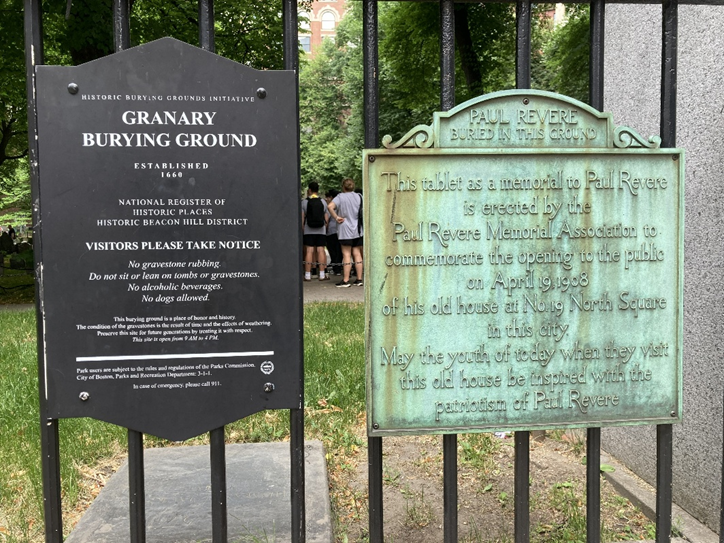
I stand before the gravestones of Sam Adams and John Hancock – they did not die on that auspicious April morning. Their talents and gifts to this country were yet needed in the years ahead. But here I stand before their mortal remains at the Granary Burying Ground on a sunny day 250 years after that April morning. The Granary Burying Ground is in the heart of Boston—in the heart of a noisy, vibrant world-class city. A “City on a Hill” as John Winthrop predicted it would become, some 150 years before that April morning in 1775.
A city on a hill cannot be hidden – it is a beacon to the world. Today, I am here in Boston when the “World Cup” soccer match is going to be played at “patriot stadium” (Gillette stadium) just outside of Boston. The visiting team is from Scotland. The city is crowded with kilted Scots and their wonderful brogue! They have come here to cheer on their countrymen. They are a friendly army.
But in 1775, the British Regulars were led that fateful day by Major John Pitcairn – a Scotsman himself. There were many Scottish regulars on the battlefield that day as well. But times have changed, and now we are friends. Boston, this “City on a Hill”, as well as this great country, is now a “Beacon to the World” for freedom and the rights of man. (Although our soccer team did not do so well!)
As I left the Granary Burying Ground, I couldn’t help but think of those men whose names I had read about since childhood. Their work was unfinished when they died. In every generation, freedom must be protected—not only on the battlefield, but in our homes, our communities, and at the ballot box. Perhaps the best way to honor their sacrifice is not simply to remember their names, but to live as worthy citizens of the nation they helped create. Are you worthy of their sacrifice? Fear not—here are some things you can do-
Fly a flag
Pray for our country
Give up your next federal holiday vacation to visit a national memorial instead.
Shake the hand of a vet and thank them for their service.
If you are a vet, then God bless you for your service!
Go vote.
Read a book on the founding of this country.
Try this book or this account. The second link (Coburn’s account) is fascinating as it tells you the most interesting details of April 19, 1775 that have come down through the years (e.g. Mother Bathericke, engaged in digging dandelions when 2 British solders begged her assistance to shelter them! See line 120 in the link).
Please comment!! Let me know if you have been to any of these wonderful places! Scroll down to find the Reply or Comment.
Always talk to your health professional before starting anything new. This information is not intended to diagnose, treat or cure any condition and is intended only for entertainment. I welcome your comments
Thanks Jackie …most interesting history lesson!
Great job, Jackie; very informative and well written. It’s great to see you expand the scope of your writing!
Great job, Jackie; very interesting and well written. Glad to see you’re branching out in your writing!
What a WONDERFUL article you have written! I feel as if I am in the midst of American history. Such a tribute to those who have gone before us and sacrificed sooooo much!
Wow! Very nicely written! Your taking us on a 1775 ride through Lexington and Concord and then bringing us back to the “Scottish invasion” today really put a nice perspective on history. Your closing paragraph is sublime. The best line is; “Perhaps the best way to honor their sacrifice is not simply to remember their names, but to live as worthy citizens of the nation they helped create.” May we all do so.
Thank you Jackie for taking us with you on your history filled journey. I enjoyed every word!